 Beverlee Rasmussen
Coaching small business owners can be challenging because every conversation is different. The International Coaching Federation’s (ICF) Core Competencies give coaches a practical framework for listening well, asking better questions and helping clients find their own way forward.
The competencies are not a script for a coaching conversation. They provide a professional foundation that helps you stay present, work in partnership with the client and keep the conversation centred on what matters most to them.
Here are some of the ICF Core Competencies that become particularly important when coaching small business owners.
Establish and Maintain Clear Agreements
A useful coaching conversation begins with clarity.
What does the business owner want to work through today? What would make the conversation valuable? How will they know they have made progress?
In small business coaching, this matters because owners can arrive with several issues at once. They may start by talking about cash flow, move into staffing and then realize the real issue is a decision they have been avoiding.
A clear agreement gives the conversation direction while still allowing the owner to discover what really needs attention.
Cultivate Trust and Safety
Small business can be deeply personal.
An owner may be carrying financial pressure, conflict with an employee, uncertainty about the future or the weight of being responsible for everyone around them.
Trust grows when the coach listens without judgement, respects the owner’s experience and creates room for them to say what they may not be saying anywhere else.
Sometimes simply having a place to think out loud changes the quality of the decisions that follow.
Maintain Presence
Presence means being fully there with the person in front of you.
That sounds simple, but it can be difficult when you know a lot about business and can already see several possible solutions.
The discipline is staying curious.
Rather than jumping ahead to solve the problem, remain with the owner long enough to understand what they are seeing, what they may be missing and what is most important to them.

Listen Actively
Good small business coaching requires listening beyond the obvious business problem.
A client may say, “I need more staff,” while also telling you they have difficulty delegating.
They may say, “Sales are down,” while describing a business with no consistent marketing process.
They may say, “I need better systems,” while revealing that every decision still has to go through them.
Active listening helps you hear both what is being said and what may be sitting underneath it.
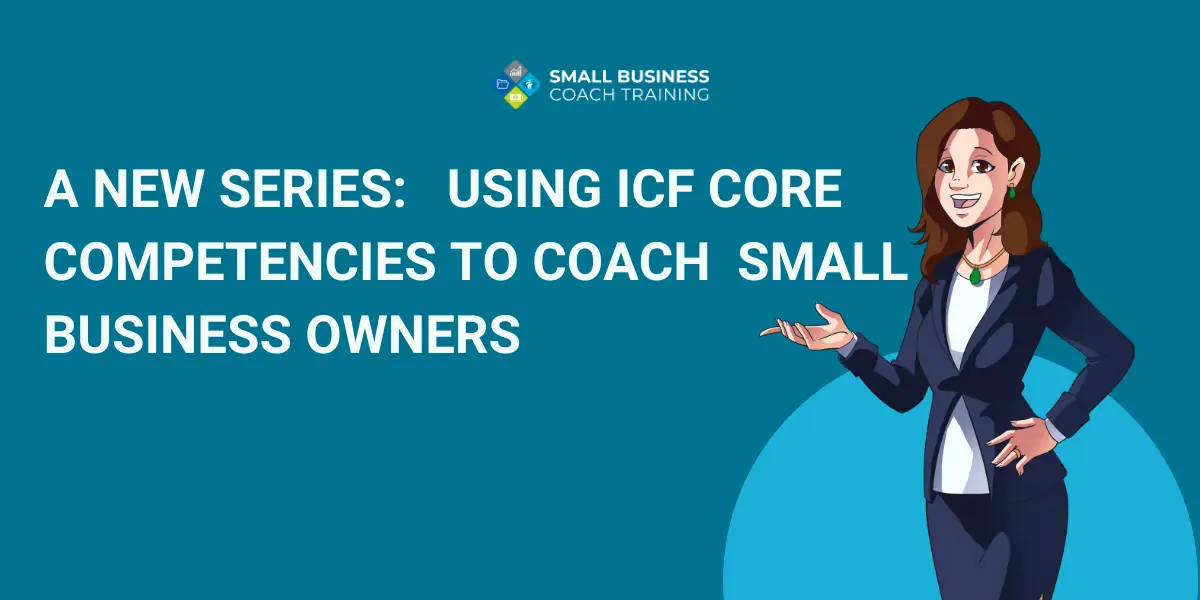
Business coach using ICF Core Competencies in a coaching conversation
Evoke Awareness
This is where good questions become powerful.
Rather than telling the owner what to do, you can help them notice patterns, challenge assumptions and see possibilities they may not have considered.
Questions such as:
- What is really getting in the way here?
- What would change if this no longer depended on you?
- What are you assuming to be true?
- What would success look like?
- What conversation have you been avoiding?
can create far more useful insight than simply providing another piece of advice.
Facilitate Client Growth
Insight matters when it leads somewhere.
Toward the end of a coaching conversation, help the owner decide what they want to do with what they have discovered.
That may mean making a decision, having a conversation, creating a system, gathering more information or simply taking one clear next step.
The action belongs to the client. Your role is to help them turn their thinking into something they are willing and able to move forward with.
What This Looks Like in Small Business Coaching
The ICF Core Competencies give coaches a strong professional foundation. Small business coaching adds another layer: understanding the environment in which the owner is making decisions.
Leadership, finance, operations, team and marketing rarely operate independently in a small business. One issue can quickly affect several others.
At Systems Business Coach®, we combine professional coaching skills with practical small business knowledge so coaches can stay in the coaching role while understanding the world their clients are navigating.
That combination helps create conversations that are both deeply client-centred and grounded in the realities of running a small business.
Take Your Small Business Coaching Skills to the PCC LevelOur Professional Certificate in Small Business Coaching is an ICF Level 2 program focused specifically on coaching small business owners.
You will strengthen your ICF coaching skills while learning how to work with the real challenges small business owners bring into the room, including leadership, systems, decision making, growth, team issues and the pressure of carrying the whole business.
If you want to become a highly skilled small business coach while working toward your PCC credential, this program was designed for that path.
Explore the Professional Certificate in Small Business Coaching
This fixes the repetition, brings the terminology up to date, keeps the article useful for “ICF Core Competencies,” “coaching small business owners,” and “small business coach training”, and sounds much more like a person who actually coaches rather than a compliance manual. ICF