
 Beverlee Rasmussen
Small business owners don’t need someone telling them to “work on the business, not just in it.” Most already know that.
The problem is that knowing what needs to change and being able to make that change are two very different things.
When cash flow is tight, the team needs attention, marketing is inconsistent and every decision seems to land on the owner’s desk, it can be hard to see a way forward.
Sometimes what they need most is someone who will listen, ask good questions and help them think.That is where a skilled small business coach can make a real difference.
If you are wondering how to become a small business coach, the work starts with learning how to coach and then learning how to apply those skills to the realities of owning a small business.Small business is personal.
The owner is often the leader, salesperson, problem solver and decision maker all at once.
A cash flow problem can quickly become a staffing problem. A hiring problem can affect customer service. One weak system can create problems across the whole business.
A good small business coach understands how all of these pieces connect and helps the owner find their own way forward.

Start With the Right Definition of Coaching
Business experience is valuable, but it does not automatically make someone a coach. A consultant may diagnose a problem and recommend a solution.
A coach partners with the client to clarify what matters, examine assumptions, make decisions, and build accountability.
Many effective small business coaches can do both within clear ethical boundaries, but they know which role they are playing at any given moment.
That distinction matters when an owner asks, “What should I do?”
Your job is not to prove you have all the answers. It is to help the owner uncover the best next move, strengthen their decision-making, and follow through. At times, you may share a framework, tool, or business observation.
The coaching conversation still centers on the client’s agenda, awareness, and ownership.
Professional coach training gives you a repeatable way to do this.
You learn how to establish agreements, listen beyond the obvious problem, ask questions that create insight, manage your own assumptions, and support accountability.
These competencies are particularly valuable with entrepreneurs, who are often accustomed to receiving advice but may have few places to think openly and strategically.
Build Fluency in Small Business Reality
You do not need an MBA or a history of owning multiple companies to become credible.
You do need enough business literacy to understand the terrain your clients are navigating. Without it, coaching conversations can become too abstract to be useful.
A capable small business coach understands how common functions connect: strategy and goals, pricing and profitability, sales and marketing, cash flow, hiring, delegation, customer experience, systems, communication, and operational execution.
You are not expected to become the client’s accountant, attorney, or marketing agency.
You need to, however, recognize the questions that reveal where a business is stuck and when a specialist’s expertise is needed.
For example, an owner may say they need more leads. The deeper issue could be unclear positioning, inconsistent follow-up, poor capacity planning, a weak sales process, or a fear of raising prices. A coach who understands these possibilities can help the client investigate rather than chase the first apparent solution.
This is also where specialization creates an advantage. Corporate leadership models can be useful, but they do not always account for the compressed roles, limited resources, and personal stakes of a 12-person company. A small business coach needs methods built for the owner who is simultaneously the sales leader, operations manager, culture carrier, and final decision-maker.
Choose Training That Develops Skill, Not Just Knowledge
The fastest way to collect coaching concepts is not necessarily the fastest way to become capable. Coaching is a practiced discipline. You need live feedback, observed sessions, structured reflection, and repeated opportunities to work with real client situations.
Look for training that combines foundational coaching competencies with a small-business-specific methodology. The strongest programs teach how people learn and change, then connect those principles to the practical challenges owners bring to a session. A useful training experience should help you move from knowing a model to confidently using it in conversation.
As you compare programs, consider these four questions:
-
- Does the training align with recognized professional coaching standards, including International Coaching Federation competencies?
-
- Will you practice business related coaching and receive specific feedback on your presence, listening, questions, and agreements?
-
- Does the curriculum address the realities of businesses not just leadership?
-
- Is there a clear pathway if you want to pursue ACC or PCC credentials over time?
Live online learning can be a strong fit if you value practice, community, and direct instructor feedback.
Self-paced learning may be more flexible for a busy professional, especially when it includes structured practice opportunities and mentor support.
The right format depends on your schedule, learning style, and how quickly you want to begin serving clients.
Small Business Coach Training offers pathways ranging from focused coaching foundations to ICF-accredited Level 1 and Level 2 education, along with a specialized Certified Systems Business Coach® credential, a globally recognized standard for small business coaches.
The goal however, is not simply to add a credential to your bio. It is to build the judgment, tools, and method needed to coach owners toward measurable business progress.

Develop a Method You Can Use Consistently
New coaches sometimes feel pressure to make every coaching session feel profound.
That is not the goal.
What matters more is having a dependable process you can return to again and again. A good coaching method helps you understand what is happening now, get clear on what the client wants, explore what may be getting in the way, consider options and turn the conversation into action.
With small business owners, the business issue and the human issue are often connected.
An owner who avoids difficult conversations may be experiencing a staffing problem.
An owner who cannot step away from the day-to-day work may need better systems, clearer roles or stronger delegation.
An owner who keeps changing direction may need help getting clear on strategy and decision making.
That is why learning how to coach small business owners takes more than learning a list of good questions. You need a method that helps you stay curious while also understanding how the different parts of a business affect one another.
At Systems Business Coach®, we teach a practical coaching method designed specifically for conversations with small business owners.
Our Presence → Possible → Plan → Perform framework gives coaches a simple structure they can return to while still keeping the conversation centred on the client.
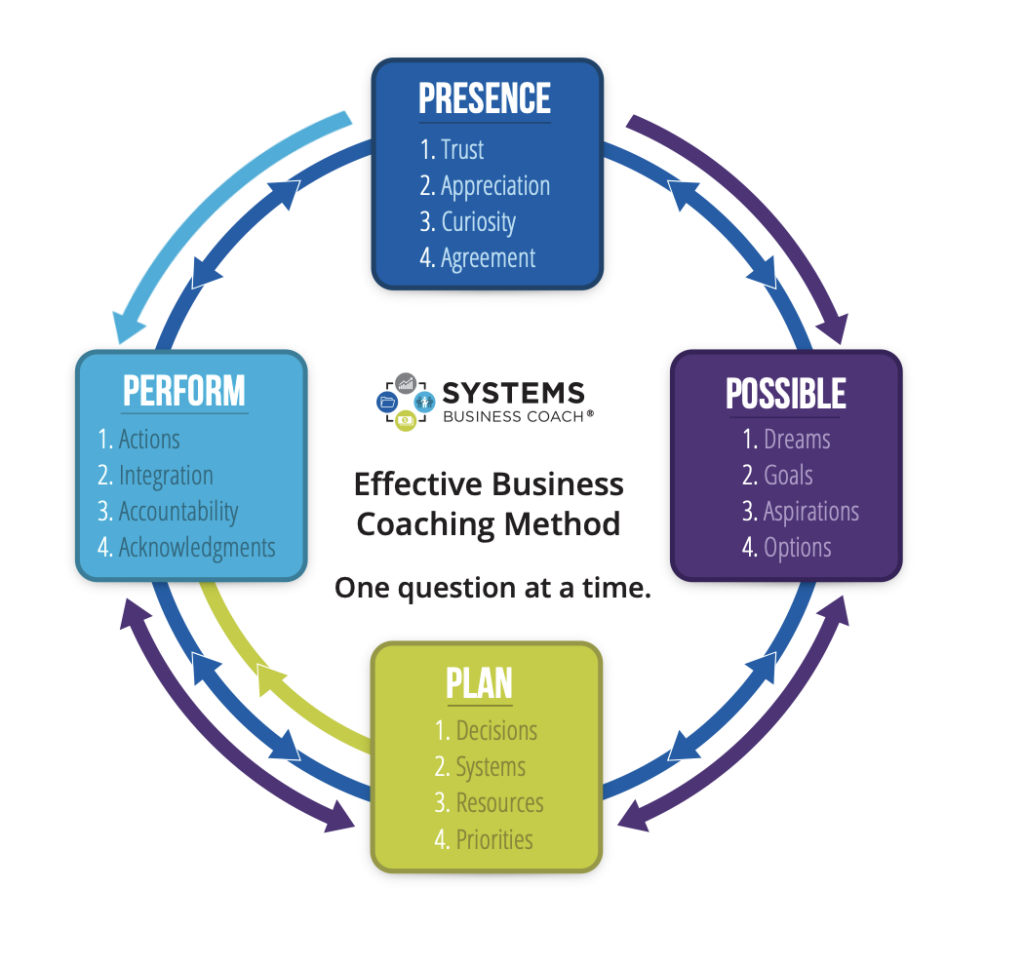
We also use business assessment tools, coaching questions and systems thinking to help coaches understand how leadership, operations, finance, team and marketing connect inside a small business.
A coaching method also helps you know where your role begins and ends. You do not need to become your client’s accountant, marketer, HR specialist or web designer.
If a client needs a financial forecast, you can help them think through the decision and then connect them with the right financial professional.
If they are considering a new website, you can help them get clear on who the site is for, what they want it to accomplish, what they are prepared to invest and what needs to happen next.
Over time, you will build your own coaching toolkit. It may include great questions, business assessment tools, ways to set goals, accountability practices and a network of professionals you trust.
The tools are there to support the conversation.
The conversation is still the work.

Earn Credibility Through Practice and Ethics
Certification can strengthen confidence and market trust, particularly when it is paired with recognized coach education.
Still, credibility is earned in the way you work. Clients notice whether you prepare, keep commitments, protect confidentiality, communicate clearly, and stay focused on outcomes that matter to them.
Begin practicing before you feel completely ready. Offer a defined number of sessions to people who fit your future client profile, with transparent expectations about your experience level and service structure.
This practice also helps you identify your best niche.
You may be especially effective with service-based firms, early-stage founders, family businesses, agencies, local retailers, or owners preparing to hire their first manager.
You can start broadly and specialize as patterns emerge. What matters is that your positioning eventually makes it easy for the right client to recognize that you understand their world.
Ethics deserve the same attention as marketing. Set clear agreements around fees, meeting cadence, communication between sessions, confidentiality, cancellation policies, and the limits of coaching.
Know when to refer a client to a therapist, lawyer, accountant, financial advisor, or other professional. Clear boundaries protect the client, protect your reputation, and make your work more effective.
Create a Sustainable Coaching Practice
A meaningful coaching career also needs a business model. Decide whether coaching will become your full-time practice, a service within consulting or advisory work, or a complement to another profession. Each route can work, but each requires different decisions about positioning, pricing, capacity and finding clients.
One of the best places to start is by creating a business plan for your coaching practice. It will help you think through who you want to serve, what you will offer, how you will price your services and how you will build a sustainable coaching business.
Many coaches begin with one-to-one coaching because it gives them valuable experience working directly with clients. As your practice grows, you may choose to add group coaching, team coaching, workshops, training or other services that meet the needs of small business owners.

When you talk about your coaching practice, make it easy for people to understand who you help and what you help them work through.
Small business owners are rarely looking for “coaching” for its own sake. They are looking for help with the things that are keeping them stuck: cash flow, staffing, systems, growth, decision making, leadership, marketing or simply having too much sitting on their shoulders.
Your job is to connect your coaching to those real business challenges.
Explain the kinds of conversations you help facilitate, the areas of business you understand and how you help owners move from where they are now toward where they want to be.
Credentials matter, especially when you are establishing your professional credibility, but they are only part of the story. Business owners also want to know that you understand their world, will listen without judgement and can help them find a practical way forward.
Relationships matter too. Get to know the professionals small business owners already trust, including accountants, bankers, lawyers, business associations, economic development organizations and other business service providers.
The clearer they are about what you do and who you help, the easier it becomes for them to confidently refer a small business owner to you.
Ready to Start Coaching Small Business Owners?
Our next Small Business Coaching Bootcamp begins October 14th, 2026.
Over six powerful weeks, you will strengthen your coaching skills, practise with others, and learn how to bring a professional coach approach to the real conversations small business owners are having every day.
If becoming a skilled, confident small business coach is where you are headed, this is a great place to start.