

 Syed Qasim
A small business owner rarely arrives with a neatly defined coaching topic. They may start with a cash flow concern, a difficult employee, a stalled marketing effort, or the feeling that every decision still lands on their desk. The ICF accreditation value of a coach education program matters because it helps professionals respond with disciplined coaching skills, ethical clarity, and a credible path for building trust – not simply more advice.
For professionals who serve entrepreneurs, however, accreditation is only part of the decision. A respected credential can open conversations and strengthen professional confidence. It does not, by itself, prepare someone to understand how sales, staffing, operations, owner leadership, and financial decisions affect one another inside a business with fewer than 100 employees.
The strongest preparation brings both together: internationally recognized coaching standards and a practical small business coaching specialization.

What ICF accreditation actually signals
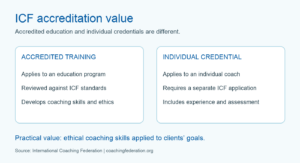
The International Coaching Federation, or ICF, is widely recognized for establishing standards for professional coaching education, ethics, and credentials. When a training program is ICF-accredited, it has been reviewed against ICF accreditation standards for coach education. Depending on the program level, that education can support a learner working toward an Associate Certified Coach (ACC) or Professional Certified Coach (PCC) credential.
This distinction matters. An accredited education program is not the same thing as an individual ICF credential. Completing training may provide required education hours and structured preparation, while the individual coach still needs to meet ICF credential requirements, which include coaching experience and the required exam, along with education, mentor coaching, and performance evaluation requirements for the chosen pathway.
That clarity is useful for prospective clients and for professionals choosing a training path. It prevents a common problem in the coaching market: broad claims of expertise without a clear understanding of what the training included or how the practitioner works.
Accreditation also creates useful guardrails. Participants learn coaching competencies that emphasize active listening, meaningful questions, client-led goals, agreements, reflection, and accountability. They learn ethical standards intended to protect the client relationship, including confidentiality, scope of practice, and appropriate boundaries.
For an accountant, consultant, economic development professional, or former business owner moving into coaching, these guardrails can be especially valuable. Their expertise remains important, but a coach approach changes how and when expertise is offered. Instead of immediately diagnosing and prescribing, the professional helps the owner think more clearly, weigh options, and choose action they can sustain.
ICF accreditation value depends on your goal
ICF accreditation has real value, but the value is not identical for every professional. Its practical return depends on how you plan to serve clients, build your practice, and describe your work.
For a newer coach, accredited training may provide a credible foundation and a clear structure for learning skills that are easy to underestimate. Asking a useful question is different from asking a leading question. Listening for the client’s values, assumptions, and patterns requires more than business experience. Learning to hold an agenda without taking over it can make coaching more effective and less exhausting.
For an established consultant or advisor, ICF education may sharpen client conversations and create a more ethical separation between coaching, consulting, and advising. A marketing agency owner, for example, could continue providing marketing expertise while using coaching skills to help a client clarify priorities, strengthen decision-making, and follow through on the right initiatives.
For coaches pursuing ACC or PCC credentials, an ICF-accredited pathway can provide the education component required for their credential goal. This may matter when working with organizations, referral partners, or clients who recognize ICF credentials as a sign of professional commitment.
There is also a personal value. Many experienced professionals have spent years being paid to provide answers. Coaching education can build the confidence to slow down, listen beyond the presenting problem, and trust an owner’s capacity to make decisions. That does not mean becoming passive. It means using your expertise with intention rather than allowing it to replace the client’s ownership.
Why accreditation alone is not enough for small business coaching
Generic coach training may teach strong core competencies while offering little exposure to small business reality. A coach may be skilled at goal-setting conversations yet feel uncertain when an owner talks about inconsistent revenue, unclear roles, pricing pressure, customer retention, or an overloaded team.
The answer is not for a coach to become the client’s accountant, lawyer, human resources professional, or operations manager. Those boundaries matter. But effective small business coaching requires enough business understanding to recognize the context, ask better questions, and help the owner see connections they may be missing.
A business is a set of interconnected systems. A hiring issue may also be a role-clarity issue. A sales problem may be connected to marketing messages, lead follow-up, capacity, pricing, or the owner’s discomfort with delegation. Repeated employee mistakes may point to missing policies and procedures rather than a lack of effort.
Without systems thinking, coaching can become a series of disconnected conversations. The client leaves each session with an action item, but the underlying pattern remains. With systems thinking, a coach can help the owner examine how leadership, finance, marketing, operations, team communication, and customer experience influence one another.
A dedicated small business specialty strengthens ICF accreditation value by connecting coaching skills with practical business understanding. It gives coaches practical ways to move from insight to action while preserving the client-led nature of coaching.
What to look for in an accredited training program
To assess ICF accreditation value for your goals, begin by identifying your professional objective. Are you building foundational coaching skills to use in an advisory role? Are you seeking an ACC or PCC path? Do you need mentor coaching? Or are you looking for a specialty that makes your work more relevant to owners and entrepreneurial teams?
Then examine the learning experience, not only the accreditation label. Strong programs give participants opportunities to practice coaching, receive feedback, understand ethics, and build confidence with real client conversations. Self-paced learning can offer flexibility, while live learning may provide practice, observation, and a community of peers. The best fit depends on your schedule, learning style, and need for accountability.
For those serving small businesses, ask whether the curriculum addresses the realities your clients bring. Look for training that includes practical tools and frameworks for leadership, planning, communication, priorities, financial awareness, operations, and team development. The tools should support coaching rather than turn every session into a consulting engagement.
It is also worth asking how the program defines outcomes. Useful education does more than help you complete hours. It helps you develop a repeatable method for serving clients with integrity. You may want resources that help owners prepare for conversations, see their business as a system, track progress, and create policies and procedures that reduce unnecessary chaos.
A coach approach that creates practical progress
Owners often need more than encouragement. They need space to think, a way to identify what matters most, and practical next steps they can carry into a demanding week. ICF accreditation value becomes practical when a coach uses these skills to help owners think clearly, choose priorities, and take action.
Consider an owner who says, “My team never takes initiative.” A consultant might immediately recommend training, meetings, or a new management tool. Those options may be useful, but coaching first explores the situation: What decisions are employees expected to make? What information do they have? Where does the owner step back in? What has worked in the past? What would responsible initiative look like?
This kind of inquiry respects the owner’s knowledge while making hidden systems visible. Appreciative inquiry adds another dimension by looking for strengths, exceptions, and progress. Rather than treating the business as a collection of failures, the coach helps the owner identify conditions that already support good work and build from there.
The result may be an organized and profitable business over time, but the path is rarely one dramatic breakthrough. More often, it is a sequence of clearer decisions, better conversations, useful routines, and actions that fit the owner’s capacity.
Credibility is strongest when it is matched by capability
ICF accreditation value becomes clearer when clients, employers, and partners can see a coach’s ethical training reflected in capable practice. Accredited education may support a recognized credential path and give you a common language for high-quality coaching.
But credentials are most meaningful when clients experience the difference in the conversation. They notice when you listen without rushing to fix. They notice when your questions reveal a pattern, when your practical tools create movement, and when you respect both their ambition and the constraints of running a small business.
Small Business Coach Training brings ICF-aligned coaching education together with a dedicated focus on the systems and decisions that shape small business outcomes. For professionals who want to serve entrepreneurs well, that combination can turn professional credibility into work that is genuinely useful.
The most valuable next step is to choose training that helps you become the kind of practitioner an owner can rely on: ethical, practical, well-prepared, and able to help them think their way toward a stronger business.
Frequently asked questions
Does completing an ICF-accredited program make me ICF credentialed?
No. Program accreditation and an individual coach credential are separate. You must still apply to ICF and meet the requirements for your chosen credential, including coaching experience and the required exam.
What value does ICF-accredited training offer a business coach?
It provides education reviewed against ICF standards, with a focus on coaching skills and ethical practice. Compare the program’s accreditation level, learning format, practice opportunities, and feedback with your professional goals.
Why add a small business coaching specialty?
Owners face connected decisions about people, sales, operations, and finance. A small business specialty helps a coach understand that context and ask more useful questions while keeping the owner responsible for decisions.