

 Beverlee Rasmussen
 The Key Takeaways
-
A business coach helps owners think more clearly and decide more confidently, not by giving advice, but by asking better questions.
-
Owners don’t need more opinions; they need structured thinking, practical tools, and accountability to move forward.
-
Good coaching looks at the whole business across leadership, operations, finance, team, and marketing, not just one problem.
-
The coach’s job is to build the owner’s judgment and systems, not to be the hero with all the answers.
-
Business coaching is not generic growth plans, guru-style motivation, or a consultant telling you what to do.
What Does a Business Coach Do?
Most people think a business coach helps you “grow your business.”
That can be part of it, and it is rarely the whole story.
A good business coach helps you run your business with more clarity, more stability, and less pressure on your shoulders. Not by handing you a generic plan, and not by telling you what to do. By helping you see what is happening, understand what matters next, and build the systems and decision-making strength to move forward with confidence.
Because business owners are humans first.
And they are carrying the weight of the world on their shoulders. They face constant decisions, long hours, uncertain finances, and the unrelenting pressure to succeed, not just for themselves, but for their employees, their families, and their communities. Many are lonely. Most have no one they can talk to.
That is where real business coaching begins.
Business coaching is not advice, it is better thinking

Advice is easy to give. It is also expensive when it misses the mark.
Most owners do not need more opinions, they need a way to sort through complexity without getting buried in it. They need to make decisions with incomplete information, week after week, while still keeping sales moving, customers happy, payroll covered, and their own energy intact.
A business coach helps an owner slow down long enough to think clearly, then move forward decisively.
Not with fluffy motivation.
With structured thinking, practical tools, and conversations that create ownership.
The simplest definition
A business coach helps a business owner:
-
- Clarify what matters most right now
-
- Understand what is working and what is not
-
- Identify the constraints that are holding results back
-
- Choose the highest-impact next actions
-
- Build systems that reduce chaos and improve follow-through
-
- Strengthen leadership, not just tactics
-
- Stay accountable to the decisions they said they wanted to make
This is not about pushing harder.
It is about building a business that can carry the load.
What a business coach actually does in sessions
Here is what business coaching looks like when it is done well.
1) Creates a safe, confidential thinking space
Most business owners are the strong one. They are the one who reassures everyone else. They are the one who absorbs the uncertainty.
A coach gives them a place where they do not have to perform.
They can say what they are worried about.
They can name what they have been avoiding.
They can admit what they do not know yet.
That alone reduces pressure, and it often releases the energy needed to solve the problem.
2) Uses a coach approach, not a tell-and-sell approach
A coach approach is different than advising. It is built on presence, curiosity, listening, and strong questions.
Instead of “Here’s what you should do,” it sounds like:
-
- What is the decision you are circling around?
-
- What do you know for sure, and what are you assuming?
-
- What is the cost of not deciding?
-
- What is the smallest next step that moves this forward?
-
- What system would prevent this from recurring next month?
This approach builds ownership. It strengthens judgment. It develops the leader, not just the to-do list.
3) Helps the owner diagnose the business without overwhelm
Many owners feel like everything is urgent, and nothing is clear.
A coach helps them step back and assess what is happening across the whole business, without jargon and without drowning in detail. The goal is to see the business as a system, not as a pile of problems.
When you see the system, you can stop reacting and start leading.
4) Organizes growth and decision-making around the full business
A business is not one thing. It is an interconnected set of functions that must work together.
If one area weakens, other areas feel it.
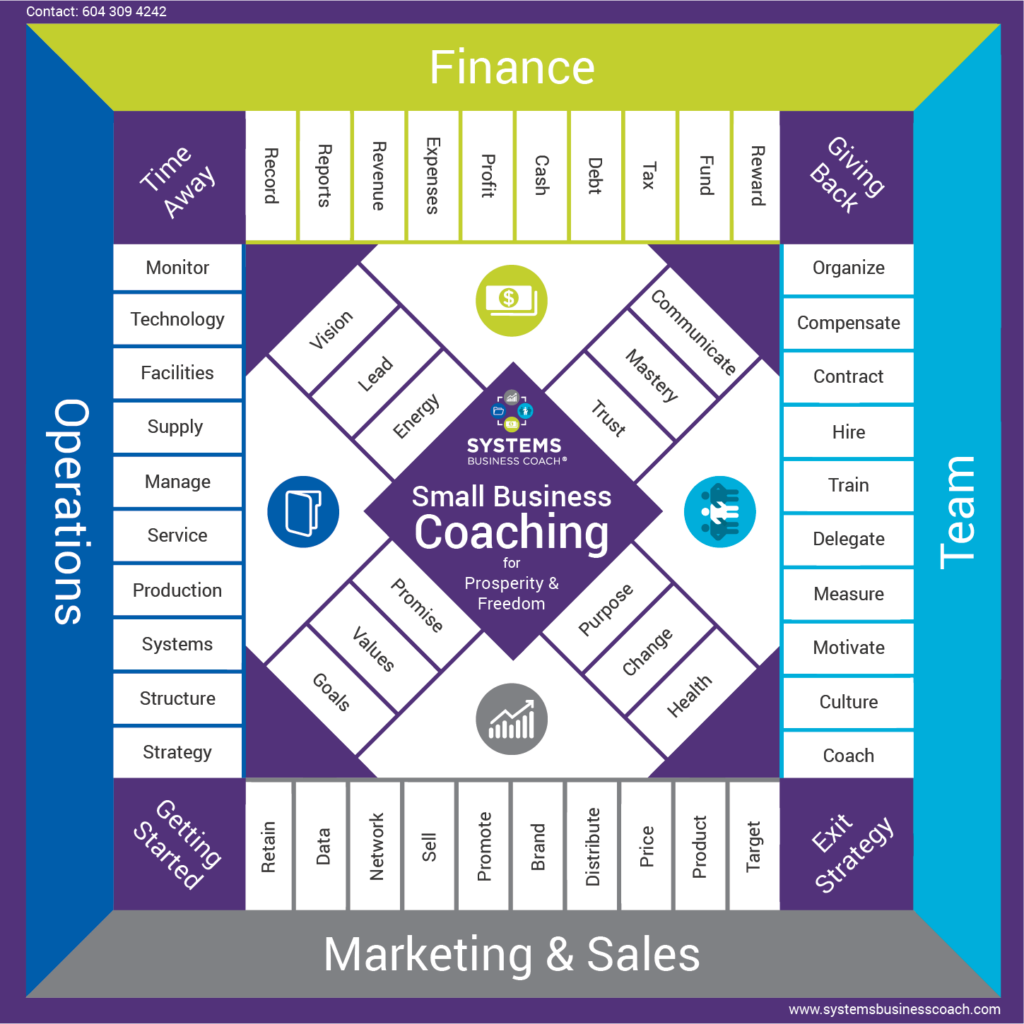
That is why strong business coaching looks at the whole game board, not just a single issue. It grounds the work in five core areas every small business must learn to run well:
-
- Leadership
-
- Operations
-
- Finance
-
- Team
-
- Marketing
This framework makes coaching more practical by providing structure. It also makes it honest because it reveals what is really driving the results.
5) Brings practical tools that translate into action
A coach is not there to entertain insight. A coach is there to support action.
That means using tools that help an owner make decisions quickly and confidently, using their real constraints, their real numbers, and their real capacity.
- Sometimes the right tool is a simple financial snapshot that clarifies whether the business model is working.
- Sometimes it is a system map that shows where follow-through breaks.
- Sometimes it is a decision filter that stops the owner from chasing shiny objects.
- Sometimes it is a communication method that prevents a team issue from turning into a full-blown crisis.
Tools make progress repeatable.
6) Builds accountability that is kind and firm

Accountability is not pressure.
Accountability is support for follow-through.
A coach helps an owner choose a clear action, set a realistic timeline, and reflect on what happened. If the action did not happen, the question is not “What is wrong with you?”
The question is “What got in the way, and what needs to change in the system so this becomes easier next time?”
That is how sustainable change happens.
What business coaching is not
Many people have been disappointed by “business coaching” that felt like hype, scripts, and generic motivational talk.
Real business coaching is not:
-
- A one-size-fits-all growth plan
-
- A personality-driven guru approach
-
- A checklist that ignores your context
-
- A pressure-based sales pitch
-
- A consultant pretending to coach
-
- A series of random tips without a system
If the coach is the hero, something is off.
The business owner is the hero. The coach carries part of the heavy pack.

Why business owners need this kind of support
Most small business owners are doing something that is quietly heroic.
They create employment.
They serve customers.
They contribute to their community.
They solve problems every day with fewer resources than people realize.
And they often do it while feeling isolated.
A business coach becomes an extension of the owner’s support system, a thinking partner who helps them lead the business they have, toward the business they want.
Not by naming their failures.
By naming their constraints, and helping them build around them.
How to know if a business coach is the right next step
Business coaching is a fit when you are saying things like:
-
- “I’m carrying too much in my head.”
-
- “I’m working hard and I can’t see what is moving the needle.”
-
- “My team depends on me for everything.”
-
- “I need to make decisions faster, and with more confidence.”
-
- “We keep having the same problems over and over.”
-
- “The business is running me.”
If any of that sounds familiar, you do not need another article about productivity.
You need a structured conversation that changes how you lead and how the business runs.
The Bottom Line
A business coach helps you run a stronger business and live a steadier life.
They help you think better, decide better, communicate better, and build systems that reduce chaos. And they help you do it in a way that respects a simple truth:
Business owners are humans first. If you are carrying the weight of the world on your shoulders, you do not need to carry it alone.