
 Beverlee Rasmussen
A business coaching certification can be a meaningful next step if you want to help owners solve real business problems without taking over their decisions. Small business owners may need to improve cash flow, clarify priorities, hire well, strengthen marketing, or create better policies and procedures. The most effective support does not come from having every answer. It comes from using a skilled coach approach that helps an owner think clearly, decide confidently, and act consistently.
That distinction matters. A generic coaching program may build foundational listening and questioning skills, but it may not prepare you for the interconnected realities of a small, owner-led business. Owners are rarely dealing with one isolated issue. A staffing challenge can affect customer service, margins, leadership capacity, and growth plans at the same time.
For professionals who want to serve this market, certification is not simply a credential to display. It can be a structured way to build ethical coaching capability, practical business fluency, and a repeatable method for supporting meaningful outcomes.
What Business Coaching Certification Should Prepare You to Do
Business coaching is sometimes confused with consulting, mentoring, or advising. Each can be valuable, and experienced professionals may use more than one approach in their work. Coaching is different because the client remains responsible for the thinking, decisions, and action.
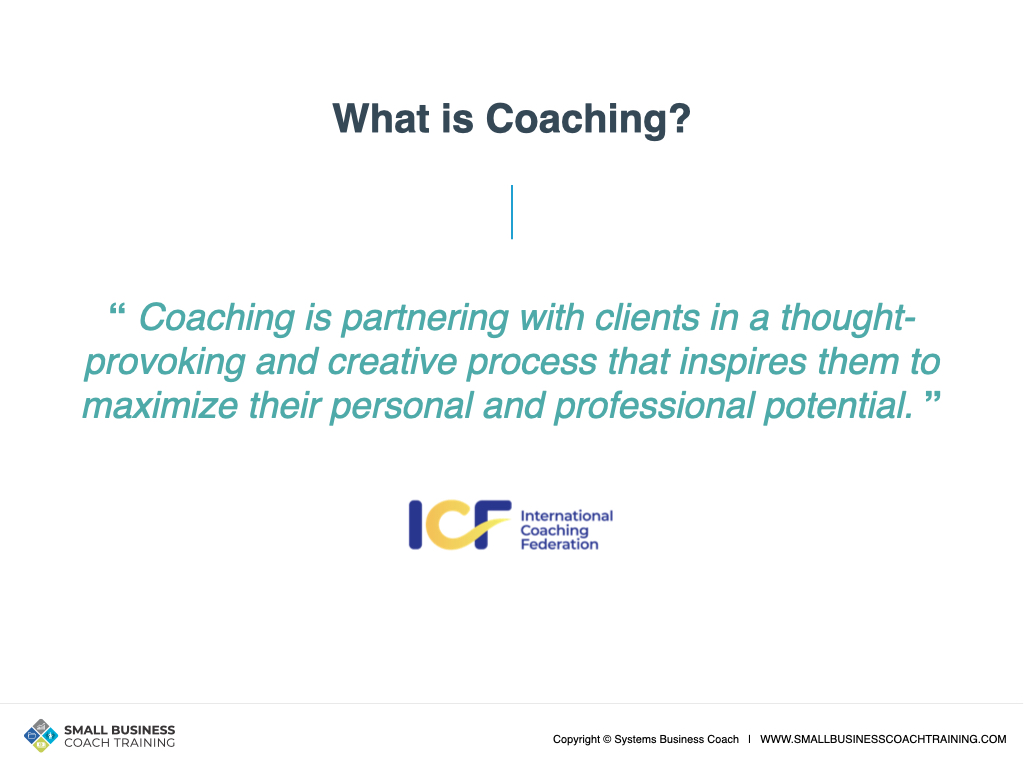
A coach approach uses deep listening, thoughtful questions, reflection, accountability, and forward movement. Rather than telling an owner exactly how to fix a marketing plan or team problem, a coach helps them identify what is happening, what matters most, what options are available, and what they are willing to do next.
In small business coaching, those conversations need to be grounded in business reality. A useful certification program may help you recognize how leadership, operations, finances, marketing, customer experience, and team performance operate as systems. When an owner sees those connections, they can move beyond reacting to the latest urgent problem and begin building an organized and profitable business.
This does not mean a coach needs to be an accountant, HR specialist, or marketing expert. It means the coach needs enough practical understanding to ask relevant questions, recognize patterns, and know when an owner may need technical advice from another qualified professional.
Coaching skill and business knowledge work together
Strong small business coaching requires two forms of capability. The first is coaching skill: establishing agreements, listening actively, maintaining ethical boundaries, asking powerful questions, and supporting client accountability. These are central to International Coaching Federation, or ICF, standards.
The second is business context. A coach who understands basic business systems can help an owner explore a missed target differently from someone who sees only a personal productivity issue. Is the goal unclear? Is there no consistent sales process? Are roles undefined? Is the owner carrying decisions that could be delegated? Are policies and procedures missing or ignored?
Neither capability replaces the other. Business knowledge without coaching skill can turn every conversation into advice. Coaching skill without business context may leave the coach uncertain when owners bring complex operational and financial concerns. The right training integrates both.

How to Evaluate a Business Coaching Certification
Not every program called a business coaching certification has the same purpose. Some focus primarily on launching a coaching practice. Others provide general leadership coaching skills. Some are designed for experienced executives, while others are accessible to people transitioning from consulting, accounting, entrepreneurship support, or business ownership.
Start by identifying the work you want to do. If you plan to help small business owners directly, look for training built around the challenges they actually face. A program focused on large corporate leadership may offer useful skills, but it may not address the pace, resource constraints, and owner-led decision-making common in small businesses.
Ask whether the curriculum includes these elements:
- ICF-aligned coaching competencies and ethical practice
- A clear method for conducting small business coaching conversations
- Systems thinking that connects people, processes, strategy, and results
- Practical tools that help clients turn insight into action
- Opportunities to practice, receive feedback, and develop confidence
A five-step checklist before you enrol
- Identify your clients. Write down the kinds of small business owners you hope to coach and the problems they bring to you.
- Compare the curriculum. Look for coaching practice, ethics, business systems, and feedback—not just lessons about marketing a coaching practice.
- Check the credential pathway. Ask which training requirements the program meets and what additional steps, if any, you would need for an ICF credential.
- Try the method. Ask how you will practise a real coaching conversation and receive constructive feedback.
- Plan your first application. Choose one conversation, assessment, or planning tool you can use in your current work after training.
Also consider the learning format. Live online training can offer practice, peer learning, and direct feedback. Self-paced training may suit a busy schedule and allow you to build skills gradually. Many professionals benefit from a combination: foundational content completed independently, followed by live practice and mentor coaching.
If an ICF credential is part of your goal, confirm whether the program offers an accredited pathway and what it includes. Training hours alone may not be the whole picture. Depending on the credential level you pursue, you may also need coaching experience, mentor coaching, performance evaluation, and an ICF application. A transparent provider will explain those requirements clearly rather than treating certification and credentialing as the same thing.
Choose a Path That Fits Your Starting Point
Your best path depends on your experience, your intended clients, and the level of professional recognition you want to pursue.
If you are new to coaching
Begin with foundations. You may already understand small business because you have owned one, advised owners, run an agency, worked in economic development, or supported entrepreneurs through a financial institution. What you need is the discipline of coaching: how to avoid jumping too quickly into solutions, structure useful conversations, and help clients create their own commitments.
Foundational training can help you test whether coaching fits your strengths and goals. It may also give you immediately useful tools for your current role, whether you are a consultant, advisor, accountant, or community-based entrepreneurship professional.
If you already work with business owners
You may not need to abandon advisory work to become a better coach. Instead, you can learn when to shift approaches. An owner may ask for your expertise on a particular issue, then need coaching space to decide how they will implement it. Clear agreements make that transition more effective and ethical.
Specialized training can also give you a common framework for recurring client challenges. Rather than reinventing every engagement, you can use systems, practical assessments, and structured questions to help owners establish priorities and follow through.
If you are pursuing ACC or PCC credentials
An ICF-accredited Level 1 or Level 2 pathway may be appropriate if you want to work toward Associate Certified Coach or Professional Certified Coach credentials. The right level depends on your current training and experience, as well as your long-term practice goals.
For this path, pay close attention to coach observation, mentor coaching, and the quality of practice opportunities. Feedback is where a coach begins to notice habits that may limit client autonomy, such as leading questions, premature advice, or an urge to solve the problem for the client.

Look for a Method You Can Use on Monday
A certification has more value when it changes how you work immediately. After a good session, an owner may not have solved every issue, but they will often have greater clarity, a decision they own, and a practical next action.
That is why practical methods matter. Systems thinking helps coaches and owners see patterns instead of treating every symptom as a separate emergency. Appreciative inquiry helps them identify strengths, possibilities, and evidence of progress without minimizing genuine constraints. Tools such as goal frameworks, business assessments, planning templates, and coaching questions provide structure without reducing the conversation to a checklist.
Small Business Coach Training brings these elements together through its Effective Business Coaching Method and Certified Systems Business Coach® program. Its specialized training is designed for professionals who want to combine ICF-aligned coaching skills with the realities of small business ownership.
A method should not make coaching rigid. Every owner has a different business, capacity, and definition of success. A restaurant owner navigating staffing pressure may need a different conversation from a professional services firm preparing to scale. The method provides a reliable structure; the coach remains responsive to the client.
Common Questions About Business Coaching Certification
Is a business coaching certificate the same as an ICF credential?
No. A training provider may issue its own certificate, while ICF credentials have separate training, experience, mentoring, evaluation, and application requirements. Check the current ICF pathway before enrolling.
Do I need to own a business before becoming a small business coach?
Not necessarily. Experience in consulting, accounting, entrepreneurship support, management, or other business-facing roles can provide useful context. A strong program should also help you build coaching skills and learn where specialist advice is needed.
What should I ask a training provider before I register?
Ask how much live practice and feedback you will receive, whether the program covers real small business challenges, which credentials it supports, what the total cost includes, and how graduates can apply their learning.
Can I start coaching small business owners while working toward certification?
That depends on your training, competence, and the services you offer. Be transparent about your qualifications, stay within your professional boundaries, and avoid presenting yourself as holding a credential you have not earned. Supervised practice and feedback can help you develop responsibly.
Certification Is Also a Practice Decision
Before enrolling, consider how certification fits into your professional model. Will coaching become your primary service, a complement to consulting, or a stronger approach within your current organization? Your answer may influence the credential level, training pace, and business development support that will be most useful.
It is also worth considering the clients you want to reach. Many small business owners will never hire a traditional executive coach, even though they face decisions with real consequences for their families, employees, and communities. Professionals who can offer ethical, practical small business coaching may expand access to support where it is needed most.
The work asks for patience. Owners can be resourceful, committed, and still overwhelmed by competing demands. Progress may begin with a clearer weekly priority, a better conversation with a team member, or one documented process that reduces daily friction. Those actions can become the foundation for larger change.
Choose a business coaching certification that helps you respect that reality: one that builds your coaching presence, strengthens your understanding of business systems, and gives you practical ways to help owners move from insight to action. When an owner can see their business more clearly and lead it with greater intention, your coaching has done more than create a good conversation. It has helped create capacity for the next decision.