
 Beverlee Rasmussen
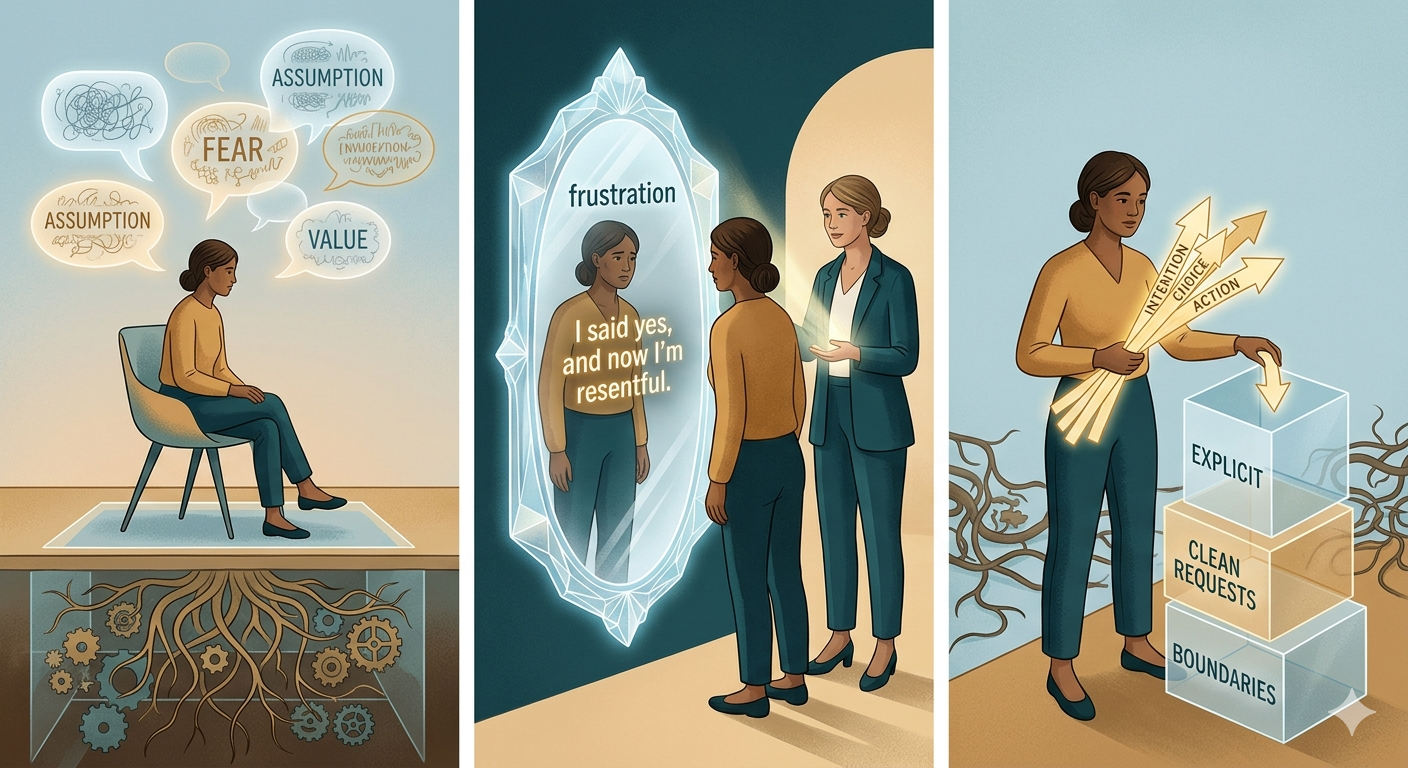
 In coaching, “make the implicit explicit” means you help the client bring what is under the surface into clear words, so they can work with it.
So much of what drives behaviour is unspoken. It sits in the background and quietly directs decisions, communication, and follow through. When we surface it, the client can see it, test it, and choose what to do next with intention.
What is usually hiding under the surface
Here are some common examples of what is often implicit:
- Assumptions: “If I say no, they’ll think I’m not committed.”
- Standards: “A good leader always has the answer.”
- Fears: “If I slow down, everything will fall apart.”
- Needs: “I need respect.”
- Values: “Fairness matters more than speed.”
- Expectations: “They should already know this.”
- Unmade requests: “I want help, and I don’t know how to ask.”
When an instructor says “make the implicit explicit,” they are pointing to a core coaching move: you notice what is implied in the client’s words, tone, or patterns, and you name it gently so the client can confirm, correct, or deepen it.
It is not about guessing what the client means. It is about offering a clear mirror and letting the client decide what is accurate.
What it sounds like in a coaching conversation
Here are a few examples of how a coach makes the implicit explicit.
Client: “I keep putting this off.”
Coach: “It sounds like there’s something about starting that feels heavy. What’s the concern you’re not saying out loud yet?”
Client: “My team isn’t stepping up.”
Coach: “What are you expecting them to do that you haven’t clearly asked for?”
Client: “I said yes, and now I’m resentful.”
Coach: “So there was a ‘no’ in you that didn’t get spoken. What did saying yes cost you?”
Client: “I want to be more confident.”
Coach: “When you say ‘confident,’ what does that look like in behaviour, and what do you believe confidence will change for you?”

In each case, the coach helps the client move from a vague experience to a specific insight that can be addressed.
Why it matters in real life coaching
When the implicit stays implicit:
- the client loops in vague frustration
- the real issue stays protected
- action plans don’t stick
When the implicit becomes explicit:
- the client gains choice
- they can make clean requests and boundaries
- they can design actions aligned with what’s actually going on
This is where coaching becomes practical. Clarity changes what a person is able to do.
A simple coaching prompt you can use
If you want to strengthen your coaching skill in this area, start with these prompts:
- “What’s the assumption underneath that?”
- “What are you making that mean?”
- “What haven’t you said yet that feels important?”
- “If we name the fear out loud, what is it?”
- “What do you want, specifically?”
These questions help clients slow down, name what is driving them, and move forward with cleaner decisions.
The bottom line
Making the implicit explicit is one of the fastest ways to create progress in coaching. It turns what feels confusing into something clear, workable, and actionable.
If you coach small business owners or leaders, this skill is a differentiator. In complex environments, people do not need more advice. They need help seeing what is already shaping their choices.
If you want to build this capability in a structured, small business focused way, Small Business Coach Training teaches coaching skills that hold up in real conversations, not just in theory.
Hashtags: #BeverleeRasmussen, #SystemsBusinessCoach